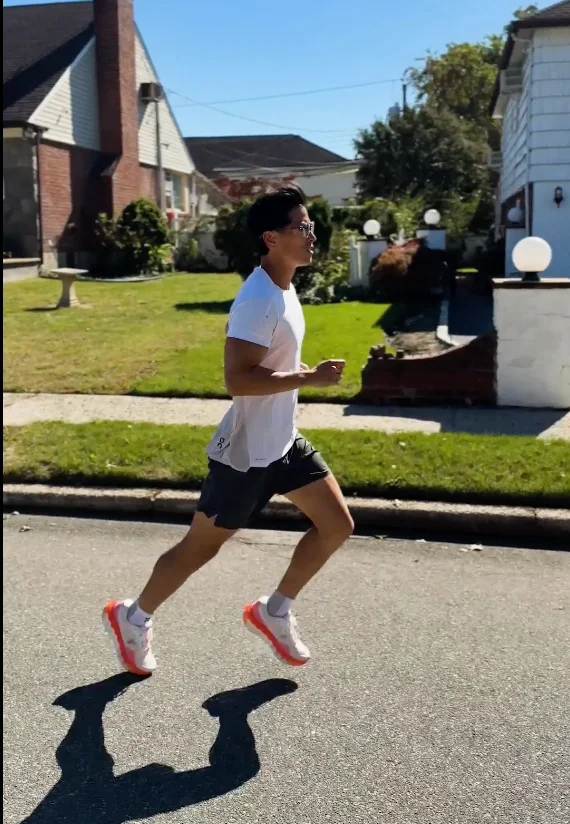
Sue Redding's Marathon Story: Overcoming Challenges with Cadence Training
Oct 12, 2026
•
5 min read
•
views
### Sue Redding's Marathon Journey: A Tale of Resilience and Technique
Sue Redding’s marathon journey reflects a powerful narrative of perseverance and adaptation. After finishing the 2022 Marine Corps Marathon in 5:01:12, she set her sights on breaking the elusive 5-hour barrier. However, the heat and humidity during the 2023 race turned her ambitions into a struggle, resulting in a time of 5:49:43. Yet, she rebounded in 2024, clocking in at 5:28:09, showcasing her determination to keep pushing her limits.
Her story is particularly poignant given her age—58—and the physical challenges that come with it. Redding candidly shares, “I’m at that stage where every joint hurts,” and recognizes that committing to marathons is no small undertaking. Still, her resolve is clear: she won’t stop racing until she finishes a marathon in under five hours.
Her marathon journey didn’t start yesterday. Redding embraced running almost four decades ago, debuting at the 2002 Baltimore Marathon shortly after turning 35, her youthful exuberance masking the realities of marathon racing. “I thought, ‘I can do anything!’ But I quickly learned that’s not the case without the right training,” she reflects on that initial experience, which ended in a painful 5:24:57. It took 11 years for her to tackle a marathon again. This time, with coaching, she entered the Marine Corps Marathon in 2013, gradually returning to that iconic race multiple times, inching closer to her goal.
In 2025, on her seventh marathon attempt, Redding employed a new training method—cadence running, a strategy she had previously overlooked. During her race, she maintained a cadence that rarely deviated from 10 to 11 minutes per mile, allowing her to finish with an impressive personal record of 4:55:54. “It’s one of my prouder moments,” Redding stated, reflecting on her achievement.
### The Cadence Breakthrough
Her newfound focus on cadence, defined as the rate at which a runner's feet hit the ground, unlocked a series of benefits that even she didn’t anticipate. The concept isn’t brand new; it had been on her radar for a while but seemed irrelevant until she attended a retreat by Another Mother Runner. There, she stumbled upon the book *Born to Run* by Christopher McDougall, which articulated the significance of cadence in a way that made sense to her. He linked it to the rhythm of the B-52’s song “Rock Lobster,” encouraging readers to find that rhythm while running. “It’s tough to get used to matching footfalls with beats,” Redding confesses, but once mastered, it’s transformative—something she witnessed firsthand during training.
Redding began timing her runs to the song’s rhythm using her Garmin watch, later applying this technique in a half marathon setting. “It was a game changer for me,” she declared, noting that the confidence she derived from understanding her cadence directly translated into her marathon performance. Now, she’s running times that surpass her younger self.
### The Significance of Cadence in Running
Cadence isn’t just a training gimmick; its importance is firmly backed by experts. Alison Freeman, a triathlon coach, emphasizes that improved cadence translates into better running efficiency. Essentially, better economy means you can run faster while exerting less energy. The compounding advantages of cadence training include reduced muscle fatigue, allowing athletes to perform stronger in the latter stages of a race. Further research indicates that increasing your cadence by just 5 to 10 percent can significantly reduce the impact force on lower body joints, diminishing the likelihood of common running injuries like runner’s knee and shin splints.
As Redding’s experience illustrates, embracing new techniques can lead to remarkable improvements. Cadence training requires patience—it can take months to feel natural and effective. But ultimately, for runners striving for personal milestones, the effort put into refining cadence could be the key to unlocking their full potential.
Source:
David Rodriguez
·
https://www.runnersworld.com/runners-stories/a74094393/underrated-running-training/