Running was never my thing. A decade ago I did one 5K on a whim with my daughter, skipped any preparation, and quit for good afterward. So when I ended up in the New York City Marathon at 60, it surprised me as much as anyone. The finish line is the easy part to report. The harder story is how close I came to never getting there.
The first step was small. In May I signed up for another local 5K, two months before my 60th birthday. My goal was narrow: I wanted to prove I could finish one. I'm an editor at
Popular Mechanics, and we share an office with
Runner's World, which made it hard to hide. Every day I walked past people who run for fun.
Preparation didn't go well. I managed a handful of runs and couldn't get past 1.5 miles, and I got frustrated. Then I looked at the course and saw how hilly it was, and I decided to wing it. I walked whenever I needed to, which was on most of the hills, because my stamina wasn't there yet.
Race day gave me what the training hadn't. The runners around me made it feel like a shared effort. I locked onto someone ahead of me running about my pace, and that pulled me toward the finish. I crossed in 35:16, an 11:20 average pace. It wasn't fast, but I finished, and that was the point.
A few months later, I was offered a spot in the [New York City Marathon](https://www.runnersworld.com/news/a74296727/2026-nyc-marathon-american-women-recap/). My first answer was no. I didn't believe I could cover that distance. A few colleagues wouldn't let it go. They pushed me and said they believed I could do it, so I said yes.
How I Trained to Go From Zero to Marathon at 60
I followed Runner's World's six-month [zero-to-marathon training plan](https://www.runnersworld.com/training/a71787211/24-week-zero-to-marathon-training-plan/). I skipped the first few weeks, since I'd already built up to five miles and the plan opens with walking. That shortcut matters later in the story.
My training was messy. I started in early August, running three times a week on local trails in the evenings, mostly easy runs of three to five miles. I added hills to most runs to get my [quads](https://www.runnersworld.com/training/a37666793/best-quad-exercises-for-runners/) ready for New York's climbs. I didn't train as much as I should have, and I'll own that.
Training stalled after the first few weeks, and not for the reason you'd expect. A couple of years earlier, doctors had found an enlarged aorta, the largest artery in the body, which carries blood from the heart to the rest of it. My doctor linked it to years of physically demanding work as an ironworker. An enlarged aorta is dangerous because if it ruptures, it can cause a fatal heart attack with little or no warning. That made me nervous about pushing hard, so I needed to talk to my [cardiologist](https://www.runnersworld.com/health-injuries/a73438687/donating-blood-runners-timing/) before going further.
Scheduling was slow. The appointment was pushed to the last week of October, and imaging couldn't happen until November. I told the doctor about the marathon, and they gave me the go-ahead to keep running with caution. I had no symptoms and no immediate concerns, so I kept going. Still, waiting on a scan with a marathon on the calendar left me uneasy, and a clearance doesn't entirely erase that.
I missed plenty of long runs and worried I was falling behind the plan. Eventually I got tired of hedging and ran 15 miles, the [minimum long run distance](https://www.runnersworld.com/training/a71797604/marathon-minimum-long-run-distance/) coaches recommend for marathon training. I felt strong the whole way and fueled well. That single run did more for my confidence than anything else in the block.
Early in the plan, I also did about four [threshold interval](https://www.runnersworld.com/training/a71270329/cruise-interval-threshold-workout/) workouts. I assumed they'd be easier than [easy runs](https://www.runnersworld.com/training/a73487190/coach-bennett-easy-pace-tips/) because they included two-minute breaks. They weren't. One session stands out: eight one-minute threshold efforts, each followed by one minute of recovery, sandwiched between a two-mile [warmup](https://www.runnersworld.com/training/a71167389/threshold-pace-warmup-hack/), a [cooldown](https://www.runnersworld.com/training/a62367832/warmup-and-cooldown-miles-weekly-mileage/), and some 30-second [strides](https://www.runnersworld.com/training/a71548788/running-strides-mistakes/) beforehand. It was harder than I expected, but I got through it.
Toward the end of the block, my pace started [improving on its own](https://www.runnersworld.com/training/a74145567/running-progress-training-signs/). That gave me enough confidence to think a sub-five-hour finish was within reach.
My strength work was basic, but I stuck with it. I did a [strength routine](https://www.runnersworld.com/training/a69917766/race-ready-strength-training-program/) three to four times a week with a 35-pound kettlebell, and I kept it up through the entire cycle. I suspect it kept me durable, though I can't isolate its effect from everything else I was doing. My usual session was 20 to 50 kettlebell swings, 10 weighted goblet squats, and 10 push-ups. The rule I followed was to keep moving and not stop between reps. I'm convinced the [kettlebell](https://www.runnersworld.com/training/a71469828/runners-kettlebells-cross-training/) is one of the best tools for this. There's no crowded gym involved, and a full session fits in a living room.
At least once a week, I slotted in two to three sets of five to 10 minutes of continuous [jump rope](https://www.runnersworld.com/training/a63273766/jump-rope-workouts/) between strength sets. It added some [plyometric](https://www.runnersworld.com/training/a70315910/plyometrics-race-ready-strength/) work for power and [durability](https://www.runnersworld.com/training/a71485391/plyometrics-marathon-durability/), which mattered more than I'd have guessed.
If you think you can't train for a marathon, I'd push back on that. I read *Runner's World* training plans constantly, and the lesson I'd pass along is simple: you don't have to be ready to start. Follow a plan, even loosely, and you'll get to the finish.
How Race Day Went
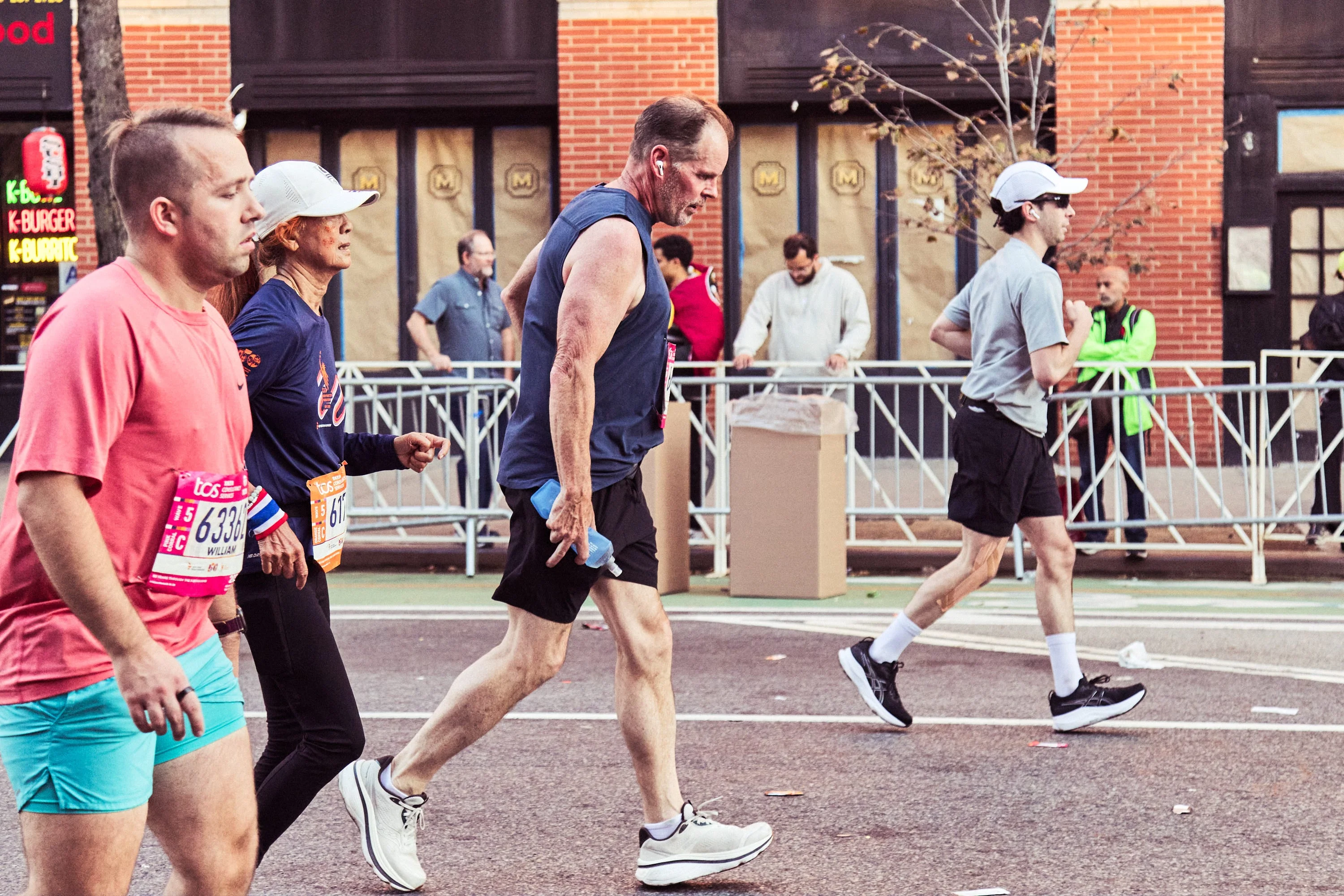
*Photo credit: Winston Zhou*
I was anxious that morning. I'd traveled from Princeton, New Jersey, and made my usual fuel: six large pancakes. I ate three before leaving the house and saved the rest for the bus ride to the start.
At the starting line, the old doubt came back. I've felt it as a writer for most of my career, from my early years as a screenwriter to adjusting to a new job at [*Popular Mechanics*](https://www.popularmechanics.com/). The question is always some version of "why am I here?" At the marathon, it hit hard. I'm not a runner, I told myself. What am I doing here? The only answer I've found is to stop arguing with the question and take the first step.
Once I was moving, I carried 12 gels and a 17-ounce handheld bottle of [electrolyte mix](https://www.runnersworld.com/nutrition-weight-loss/a73207488/when-runners-need-to-drink-electrolytes/). I kept the effort easy, and for most of the race I could breathe through my nose if I wanted to. That surprised me.
The best parts were running past buildings I've worked in and hearing the crowds. I never turned on my music. The cheering was loud enough to carry me the whole way.The New York City Marathon has a particular electricity, and it isn't the kind that comes out of a crisis. Five boroughs turn into one long day of strangers cheering for strangers. I'd never run a marathon before, so I expected the city to be the backdrop. It became the main character.
Plenty of people will tell you a big city can come together. Seeing it happen on a day with no grief behind it hit differently. In a stretch when the news feels heavy, that kind of unprompted showing up is worth noticing, and it's the part of race day I keep thinking about.
## How the Race Actually Went
Somewhere past the halfway mark, I did the math and admitted a sub-five-hour finish was gone. So I dropped the time goal and committed to finishing. That was the best decision I made all day. My family found me around mile 17, which pushed me through miles 19 and 20, the stretch that hit me hardest.
I crossed in 5:18:56. My colleagues were waiting near the [finish line](https://www.runnersworld.com/training/a69134351/mental-strategies-marathon-finish/), holding my medal. I felt like I'd proven something to myself, and having my family there to see it made it real.
## Lessons for First-Timers Over 50
Here's what I'd pass along to anyone in their fifties lining up for a first marathon. None of it is about pace.
## Use the Runners Around You
The same thing that got me through my 5K showed up again around mile 18 or 19. I looked up and saw a woman in a [hydration vest](https://www.runnersworld.com/nutrition-weight-loss/a73741026/marathon-hydration-strategy/) with a pink sign on her back: "22 weeks pregnant." My first thought was, "I'm following you, because you're my new inspiration." If she could run 26.2 miles while [pregnant](https://www.runnersworld.com/news/a71077247/calli-hauger-thackery-boston-marathon-pregnant/), I had no business quitting.
## Lean on Your Cheerleaders
At mile 20, I accepted I wasn't breaking five hours. Still, I was proud I'd made it past mile 15, the [farthest I'd ever run](https://www.runnersworld.com/training/a60009993/how-to-run-longer/). I saw my family at mile 17, and I suspect that timing mattered. Had I spotted them earlier, I think I would've burned through my energy and struggled more later.
My family went all in. They made "Team Smith" shirts, and a crowd of friends and relatives came out to watch. My son FaceTimed in from Paris. I only got a minute with them, but that minute carried me for the last nine miles. Support doesn't need to last long to matter. It needs to land at the right moment.
## Take Baby Steps
For me, the hardest part was mental. Past mile 15, I started thinking of the rest of the course as something I couldn't see in full. So I borrowed an image from driving at night: your headlights show you maybe 50 feet of road, and that's enough to keep going. You don't need the whole route. You need the next stretch.
I told myself I only had to run two more miles, then two more after that. Before I knew it, I'd reached the 23-mile mark. The [mental side of the marathon](https://www.runnersworld.com/training/a73512965/marathon-mental-tips/) is where most first-timers struggle, and breaking it into small, manageable pieces is an underrated tactic.
## Never Give Up
Running the marathon reminded me of my early twenties. I graduated from film school in Ithaca, New York, in 1988, spent some time in Los Angeles, and then moved back to New Jersey. People said I'd never sell a script from New Jersey. I sold four. They said I'd never get a movie made. I did that too. I wanted to prove those people wrong, and I approached 26.2 miles the same way.
I also have three kids in their early and mid-twenties. I wanted to show them that you can do what you set your mind to, and to reinforce a family rule that's stuck: never, ever give up.
## Be Prepared to Fail
This one is the part I'd push back on a little, though I still agree with it. When I look at my kids' lives, I see enormous pressure on their generation, amplified by social media, not to fail at a goal they've set. Failure looks like a verdict instead of a step.
My own work taught me otherwise. Whether I was picking up tools or construction techniques, I learned by trying, messing something up, and trying again, better. The marathon reinforced that. Succeeding at something usually means failing at it many times first, and that's how you learn and improve.
It's a bit of a slogan, but the mechanism holds up. The useful takeaway isn't that failure is good in itself. It's that a missed goal is information, and you only get it by making attempts that might not work.
## What This Means If You're Considering Your First Marathon
If you're over 50 and thinking about a first 26.2, don't measure yourself by the clock. My 5:18:56 is a fine number, but it's not the headline. The headline is that I changed the goal mid-race without quitting, leaned on the people around me, and kept going in small increments until the finish. Those skills transfer well beyond a single race, and they're probably more useful to you than any training plan.